
Knee pain that has crept from occasional to constant raises a question many people put off asking: is it time to think about a knee replacement?
Here, Consultant Orthopaedic Surgeon Mr David Stitson explains the signs that suggest surgery may be worth discussing, what actually decides whether you are a suitable candidate, and why the answer is rarely about your age or your X-ray alone.
Contents
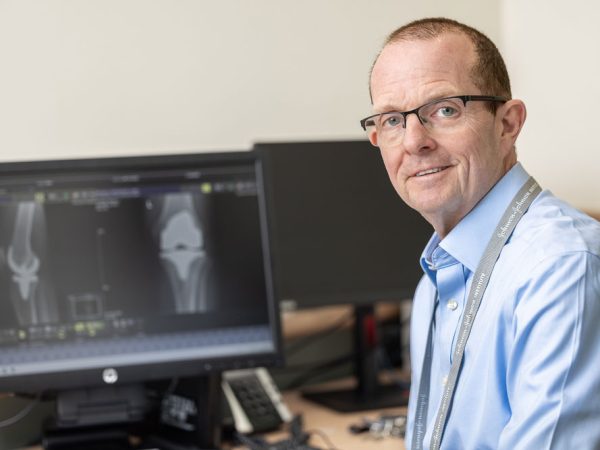
Toggle“there is no single score, age or scan result that makes someone an ideal ‘candidate’ for a knee replacement. It’s a shared decision we’ll make, based on the full picture.”
The short answer
You are likely to be a good candidate for a knee replacement if damage to your knee joint, most often from osteoarthritis, is causing pain and disability that affects your quality of life, and sensible non-surgical treatments have stopped giving you enough relief.
Beyond that, the decision is personal. It depends on how your knee affects your day-to-day life, what you want to get back to, your general health, and a careful clinical assessment.
In other words, there is no single score, age or scan result that makes someone a ‘candidate’. It is a shared decision you make with your surgeon, based on the full picture.
What does a knee replacement involve?
Knee replacement surgery (knee arthroplasty) removes the worn, damaged surfaces of the knee joint and replaces them with precisely fitted implants, usually made of metal and a medical-grade plastic bearing that creates a smooth, stable gliding surface. The aim is to relieve pain and restore function so you can get back to the things you enjoy.
Not every knee needs the same operation. Mr Stitson offers a range of options, and part of deciding whether you are a candidate is working out which procedure suits your knee:
Total knee replacement
The whole joint surface is resurfaced. This is the most commonly performed option for widespread arthritis.
Partial knee replacement
Only the damaged compartment is replaced, which may suit patients whose arthritis is confined to one area of the knee.
Revision knee replacement
for people who have previously had a knee replacement that has worn or failed.
When Should You See a Knee Specialist?
Occasional knee stiffness after exercise is common and often nothing to worry about. However, you should consider seeing an orthopaedic specialist if you experience:
- Knee pain that persists for more than a few weeks or keeps returning
- Swelling, warmth or redness around the joint
- A feeling of instability, or the knee giving way
- Locking, catching or an inability to fully straighten the knee
- Pain that disturbs your sleep or limits everyday activities
Early diagnosis often means simpler, less invasive treatment. In many cases, physiotherapy, activity modification or targeted injections can resolve symptoms without the need for surgery, but the right diagnosis is essential to choosing the right treatment.
Take the assessment below to see if knee replacement surgery is appropriate for your knee pain.
5 Signs you might be a good candidate for a knee replacement
Only a specialist knee assessment can confirm whether surgery is right for you, but the following are common signs that it is worth a conversation.
1. Pain that limits everyday life
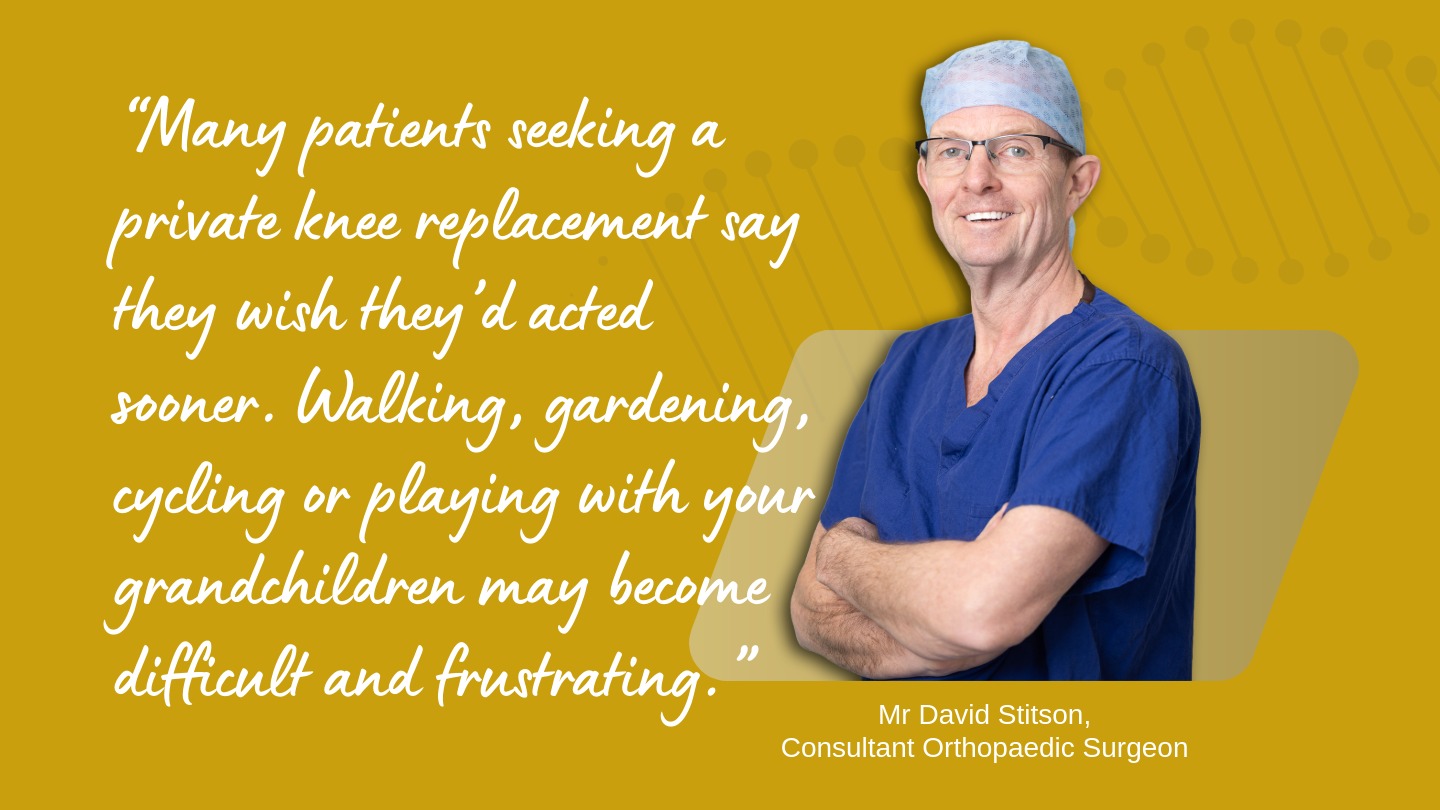
Knee pain that makes walking, climbing stairs, getting in and out of the car or rising from a chair a struggle is one of the strongest indicators. Many patients tell us they have quietly given up things they love; country walks, golf, playing with grandchildren, because of their knee.
2. Pain at rest or at night
Moderate to severe pain that continues when you are sitting still, or that wakes you at night, suggests the joint damage has progressed beyond what activity changes alone can manage.
3. Stiffness, swelling or loss of movement
A knee that will no longer fully bend or straighten, or that swells repeatedly and does not settle with rest or medication, can signal significant wear inside the joint.
4. A changing knee shape
Arthritis often wears one side of the knee faster than the other, leading to an increasingly bow-legged or knock-kneed appearance. Correcting alignment is an integral part of knee replacement surgery.
5. Non-surgical treatments are no longer enough
Most people try physiotherapy, strengthening exercises, weight management, painkillers, walking aids or injections first, and these can help a great deal for a time. When they no longer provide lasting relief, surgery becomes a reasonable next step to explore.
Common myths about who can have a knee replacement
Some people put off seeking advice because they assume they will be turned away. Current thinking has moved on, and national guidance from NICE (the National Institute for Health and Care Excellence) makes clear that people should not be excluded from consideration for joint replacement simply because of their age, sex, weight, smoking or other health conditions.
Here are some of the misconceptions we hear most often:
Knee replacements have been performed successfully at all ages.
While it Is true that the surgery is more common in older adults primarily due to age-related joint degeneration, it is not exclusive to them. Knee replacement surgery can be beneficial for anyone with severe knee issues, regardless of age.
For younger, active patients, options such as partial knee replacement or joint-preserving surgery may also be discussed.
Age alone is not a barrier.
What matters is your general health and fitness for the anaesthesia to be safe, which is checked carefully at pre-assessment. While most patients are between 60 and 80 years old, knee replacements are frequently and safely performed on patients in their 80s and even 90s.
Mr Stitson and his team at the Nuffield Health Plymouth Hospital assess each patient carefully, considering:
- General fitness and heart/lung function
- Bone strength and joint condition
- Existing medical conditions
- Your goals for recovery and independence
Weight is not a reason in itself to refuse surgery.
Maintaining a healthy weight is essential for overall well-being, but it’s impact on joint health is particularly significant.
Excess weight can lead to increased joint stress, inflammation and altered joint mechanics, all of which contribute to joint pain and the development of conditions like osteoarthritis.
Reaching a healthier weight can reduce risks and help recovery, so Mr Stitson may discuss it with you.
X-Ray Imaging confirms the diagnosis and helps with planning.
The decision to perform knee surgery is based on how your knee affects your life, not the X-ray alone.
These findings give a clear, objective view of how advanced the wear and tear (osteoarthritis) in the joint has become, and they’re often graded on a standard scale to help describe severity.
An X-ray is a vital and often sufficient tool for confirming hip osteoarthritis and deciding whether hip replacement surgery is the right path forward.
Early intervention plays a crucial role in halting or slowing down progression.
Delaying can mean losing strength and fitness, which may make recovery harder. Timing is best discussed with Mr Stitson rather than guessing. Initially, you might experience sporadic discomfort, especially after physical activity or extended periods of standing. As time passes, the pain can become more frequent and intense.
Ignoring knee pain not only affects your physical capabilities but may also lead to physical adaptations that can stress other areas like the lower back, causing additional problems.
Addressing knee pain promptly can mitigate any issues and prevent the occurrence of more serious problems.
What happens at a knee assessment?
Deciding whether you are a candidate isn’t something you should do on your own. At a private consultation with Mr Stitson at the Nuffield Health Plymouth Hospital, your assessment will typically include:
- A detailed conversation – about your symptoms, how long they have been present, what treatments you have tried, and what you want to be able to do again.
- A physical examination – checking range of movement, stability, alignment and strength, and ruling out pain coming from elsewhere, such as the hip or spine.
- Imaging – weight-bearing X-rays are the mainstay for assessing arthritis. An MRI or CT scan may sometimes be recommended, and CT is used when planning a custom-made knee replacement.
- A review of your general health – including medical history, medications and any conditions that could affect anaesthesia or recovery.
- An honest discussion of options – including non-surgical approaches, the different types of surgery, the expected benefits and the risks, so you can make an informed choice.
Quick self-check: is it time to see a knee specialist?
Consider booking an assessment if you answer “yes” to several of these:- My knee pain affects what I can do most days.
- I take painkillers regularly just to get through the day.
- My knee aches at rest or disturbs my sleep.
- I have tried physiotherapy or injections without lasting benefit.
- I am avoiding activities, trips or hobbies because of my knee.
- My knee looks more bowed or knock-kneed than it used to.
Understanding what a knee replacement can, and can’t, do
A realistic understanding of the outcome is an important part of being a good candidate.
Most patients experience a significant reduction in pain and improvement in mobility, and data from the UK’s National Joint Registry shows a continued reduction in revision surgery, with implants lasting longer and outcomes improving year on year.
A new knee is not a brand-new ‘natural’ knee.
Most pain and swelling settles within around three months, but some discomfort with stairs or prolonged sitting can linger a little longer.
High-impact activities are generally not advised, whereas walking, cycling, swimming and golf are often very achievable. Like any operation, knee replacement carries risks, including infection, blood clots, stiffness and, occasionally, the need for further surgery.
You can read more in our article on the benefits and risks of knee replacement surgery.
Getting the most from your knee replacement consultation
It helps to arrive with a few questions in mind. You might ask:
- Is my pain coming from arthritis in the knee, or could something else be involved?
- Which type of knee replacement would suit me, total, or partial, and why?
- What non-surgical options are still worth trying?
- What would happen if I waited?
- What does recovery look like, and when could I drive, return to work or get back to my hobbies?
- Is there anything I can do now to improve my outcome?
If you have already been advised to have surgery and would like reassurance, a second opinion is always a reasonable request. It is your knee, and you should feel confident in the plan.
Private knee replacement for patients across the South West
Mr Stitson sees patients from across Devon, Cornwall and beyond, including Plymouth, Exeter, Torquay, Truro, Barnstaple and Taunton, at the Nuffield Health Plymouth Hospital on Derriford Road.
Choosing private care means you can be seen promptly (usually within 4-6 weeks), choose when your treatment takes place, and be looked after by the same consultant from your first appointment through to recovery.
You do not need a GP referral to book. Mr Stitson accepts referrals directly from patients, from GPs, via private medical insurers, and from physiotherapists, osteopaths and chiropractors.
For self-funding patients, knee replacement prices start from £16,824, including pre-assessment, treatment and post-discharge care, and finance is available through the Nuffield Hospital in Plymouth.
FAQs
Q: Is there a minimum or maximum age for knee replacement?
A: No. Suitability depends on your symptoms, the condition of your knee and your general health rather than your age. Most patients are between 50 and 80, but successful knee replacements are performed well outside that range.
Q: Can I have a partial knee replacement instead of a total?
A: Possibly. A partial knee replacement may be suitable if arthritis is confined to one area of the knee and the ligaments are healthy. Mr Stitson will advise which option is best after examining you and reviewing your imaging.
Q: How long will I be in hospital?
Q: How long is recovery?
A: Knee rehabilitation starts straight away, with physiotherapy on the ward and an exercise programme to follow at home. Most pain and swelling settles within about three months, with continued improvement for up to a year.
Q: Do I need a GP referral to see Mr Stitson?
A: No. You can contact Mr Stitson’s practice directly on 01752 761818 (or email enquiries@orthopaedicsplymouth.co.uk if you’d prefer), although referrals from GPs, insurers and other practitioners are also welcome.
Expert Knee Assessment in Plymouth
If you’re experiencing ongoing knee pain, Mr David Stitson at the Nuffield Health, Plymouth Hospital offers a thorough, expert private assessment and a full range of treatment options, from physiotherapy and injections through to knee replacement surgery, tailored to your diagnosis and lifestyle.
To discuss your symptoms and explore whether joint replacement surgery is the right option for you, contact Mr David Stitson, Consultant Orthopaedic Surgeon, at the Nuffield Hospital, Plymouth.
- Call: 01752 761818
- Visit: www.orthopaedicsplymouth.co.uk
- Email: enquiries@orthopaedicsplymouth.co.uk
Take the Next Step…
If joint pain is stopping you from doing the things you love, book a consultation with Mr Stitson to discuss your options.
– Consult Your GP: If you are experiencing joint pain and are considering surgery, start by booking an appointment with your GP. They will be able to refer you to a specialist if needed.
– Understand Your Options: There are the key avenues you can explore to speed up your access to joint surgery contributing to a swifter recovery and getting you back on your feet sooner.
– Do Your Research: Familiarise yourself with different types of joint replacement procedures and what each one involves.
– Speak with Mr Stitson: Book a consultation with David Stitson, a consultant orthopaedic surgeon based in Plymouth, to discuss what might be the best approach for you personally. He will provide detailed information specific to your situation.
– A consultation helps you understand:
- What is causing your pain
- Whether joint surgery is appropriate
- Alternatives to surgery
- Expected recovery and outcomes
Surgery may sound daunting, but for many, it provides much-needed relief and the chance to regain mobility. This step can be pivotal in improving your quality of life, helping to reduce pain and stiffness in your hip or knee, dramatically.
By addressing the underlying issues, joint surgery can pave the way for a more active lifestyle, allowing you to return to the activities you love without the constant concern of hip or knee pain holding you back.
Taking action now may help you regain confidence, mobility and quality of life.
Is it time to see a Knee specialist? Get Private Orthopaedic Surgery in Plymouth in just 4-6 weeks
⇒ Consultation in 7 days or less
⇒ Consultation to surgery, 4-6 weeks
About Knee Surgery
Knee replacement surgery replaces the worn out, painful and stiff knee joint with a new prosthetic joint. This procedure which may be a partial or a total replacement is normally performed under spinal anaesthesia and is usually followed by a night or two in the hospital. Day-case knee replacement surgery may be an appropriate option for you.

About Mr Stitson
David Stitson is a Plymouth-based Consultant Trauma and Orthopaedic Surgeon. Trained both in the UK and internationally, he has worked in medicine for more than 20 years for the NHS, for the Royal Air Force and in private practice. Mr Stitson operates privately at the Nuffield Health Hospital, Plymouth.

Are you ready to Take the Next Steps to improve your mobility?
Living with constant joint pain is not something you have to accept as part of ageing. Many people in their late 60s and 70s find that a private joint replacement restores their mobility and transforms their quality of life.
📞 To discuss your symptoms and explore whether joint replacement surgery is the right option for you, contact Mr David Stitson, Consultant Orthopaedic Surgeon, at the Nuffield Hospital, Plymouth.
- Call: 01752 761818
- Visit: www.orthopaedicsplymouth.co.uk
- Email: enquiries@orthopaedicsplymouth.co.uk
Take the first step towards a more comfortable, active life today.
The Nuffield Plymouth CQC Rating
The Nuffield Hospital has a history that spans over half a century and has built a reputation for high standards of care, professionalism and expertise in delivering health services. They aim for continuous quality improvement in everything they do.
Active Quality and Governance programmes are in place at the Nuffield Hospital Plymouth. As part of this, the hospital is inspected by independent healthcare regulators to ensure it meets the fundamental standards of quality and safety as determined by the regulating body (CQC).
In the most recent inspection, Plymouth Nuffield Hospital was rated as ‘Good’ overall, however, the surgical element of the inspection was rated as ‘Outstanding’. The hospital was referred to as:
“Outstanding in effective and caring, and
Good in safe, responsive and well-led.”