If you have been living with hip pain, stiffness or a nagging limp, an X-ray is usually the first step your doctor will suggest.
It is quick, painless and gives an immediate picture of what is happening inside your joint. But does it actually tell you whether you need a hip replacement? The honest answer is partly. An X-ray is an essential piece of the puzzle, but it doesn’t always tell the whole story on its own.
Contents
Toggle“An X-ray is excellent at revealing the changes associated with hip problems giving a clear, objective view of how advanced wear and tear in the joint is.”
What an X-Ray Shows
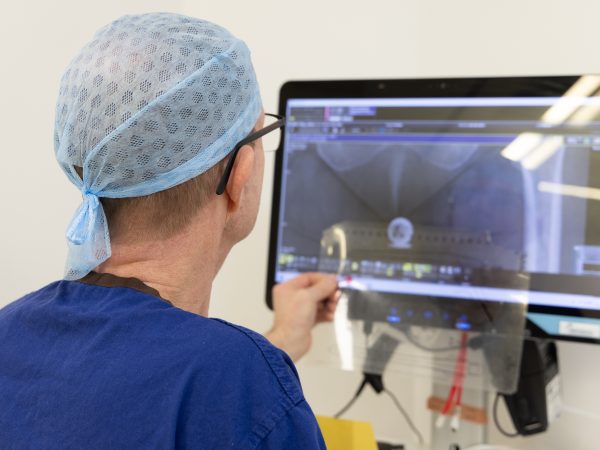
An X-ray is excellent at revealing the changes associated with hip problems. When Mr David Stitson examines a hip X-ray, he is typically looking for:
- Joint space narrowing – a sign that the protective cartilage between the ball and socket has worn thin
- Bone spurs (osteophytes) – small bony growths that form around a joint as it tries to stabilise itself
- Changes in bone density or shape – including cysts, sclerosis (hardened bone), or deformity of the femoral head
- Alignment issues – whether the joint is sitting and moving as it should
These findings give a clear, objective view of how advanced the wear and tear (osteoarthritis) in the joint has become. They are often graded on a standard scale to help describe severity such as Mild, Moderate or Severe.
Why an X-Ray Alone Is Not Enough
When Diagnosing Hip Pain
The catch: X-rays only show bone. They cannot directly image cartilage, muscles, tendons, ligaments or the labrum (the ring of cartilage that surrounds the hip socket). This creates two common mismatches:
- X-rays can look “not too bad” while symptoms are severe. Cartilage can be significantly damaged before it shows up as joint space narrowing on an X-ray.
- X-rays can look quite worn while symptoms are mild. Some patients have X-rays showing significant arthritic change, yet report only minor discomfort.
Because of this, a consultant orthopaedic surgeon like Mr Stitson will not always rely on the X-ray in isolation. Your reported pain levels, how the condition affects your daily life, your range of movement and a hands-on physical examination are all weighed alongside the imaging to build an accurate picture of what is really going on.
Do I Need an MRI Scan to Confirm My Hip Pain Diagnosis?
Not always, but sometimes, yes. An MRI scan becomes valuable when:
- Your X-ray looks relatively normal, but your symptoms suggest a significant problem
- There’s suspicion of a soft tissue problem, such as a labral tear, muscle or tendon damage, or inflammation of the joint linin
- Mr Stitson needs to rule out other causes of hip pain, such as avascular necrosis (loss of blood supply to the bone) in its early stages, which can be invisible on X-ray but visible on MRI
- If pre-surgical planning requires a more detailed view of the surrounding soft tissue and bone quality
If your X-ray already shows clear, advanced osteoarthritis that matches your symptoms, an MRI usually isn’t necessary, the diagnosis is already clear enough to discuss treatment options, including hip replacement surgery.
Which Diagnostic Process Is Best to Show Each Condition?
Different imaging tools are suited to different jobs. Here’s a simple breakdown:
Condition | Best Diagnostic Tool | Why | Recommended Treatment/Procedure |
Osteoarthritis (bone-on-bone wear) | X-ray | Clearly shows joint space narrowing, bone spurs, and bony deformity | Hip replacement surgery (or conservative management for milder cases) |
Labral tears or soft tissue damage | MRI | Captures cartilage, ligaments, and the labrum in detail | Hip arthroscopy or labral repair |
Avascular necrosis (early stage) | MRI | Detects loss of blood supply before bone changes appear on X-ray | Core decompression surgery, or hip replacement if advanced |
Fractures | X-ray (sometimes CT for complex cases) | Bone breaks are usually clear on standard X-ray | Surgical fixation or hip replacement, depending on fracture type and location |
Infection or inflammation | MRI (with blood tests) | Highlights soft tissue swelling and fluid not visible on X-ray | Antibiotic treatment, with surgical washout or drainage if needed |
Pre-surgical planning | X-ray plus MRI/CT as needed | Combines bone alignment data with soft tissue and structural detail | Tailored surgical approach based on combined imaging findings |
Is Hip Replacement Surgery the Right Path?
An X-ray is a vital and often sufficient as an investigation for confirming hip osteoarthritis and deciding whether hip replacement surgery is the right way forward. But it is not always used in isolation. A thorough assessment of your symptoms, a physical examination, X-ray imaging and an MRI scan where needed, gives the clearest and most reliable diagnosis.
If you are experiencing ongoing hip pain and want a rapid, accurate diagnosis, Mr David Stitson offers private consultations and diagnostic imaging at the Nuffield Hospital in Plymouth, with personalised treatment plans for hip and knee conditions, including hip replacement and revision surgery.

Are you ready to Take the Next Steps to improve your mobility? Book Your Private Hip Consultation with David Stitson
If hip pain is holding you back from the life you want, whether that’s walking the coast path, keeping up with grandchildren, or simply a good night’s sleep, the first step is a conversation. There is no obligation and no need for a GP referral to get started.
Living with constant hip pain is not something you have to accept as part of ageing. Many people in their late 60s and 70s find that a private hip replacement restores their mobility and transforms their quality of life.
To discuss your symptoms and explore whether hip replacement surgery is the right option for you, contact Mr David Stitson, Consultant Orthopaedic Surgeon, at the Nuffield Hospital, Plymouth.
- Call: 01752 761818
- Visit: www.orthopaedicsplymouth.co.uk
- Email: enquiries@orthopaedicsplymouth.co.uk
Take the first step towards a more comfortable, active life today.
Is it time to see a Hip specialist? Get Private Orthopaedic Surgery in Plymouth in just 4-6 weeks
⇒ Consultation in 7 days or less
⇒ Consultation to surgery, 4-6 weeks
The Nuffield Plymouth CQC Rating
The Nuffield Hospital has a history that spans over half a century and has built a reputation for high standards of care, professionalism and expertise in delivering health services. They aim for continuous quality improvement in everything they do.
Active Quality and Governance programmes are in place at the Nuffield Hospital Plymouth. As part of this, the hospital is inspected by independent healthcare regulators to ensure it meets the fundamental standards of quality and safety as determined by the regulating body (CQC).
In the most recent inspection, Plymouth Nuffield Hospital was rated as ‘Good’ overall, however, the surgical element of the inspection was rated as ‘Outstanding’. The hospital was referred to as:
“Outstanding in effective and caring, and
Good in safe, responsive and well-led.”