Knee pain that worsens over time, limits your mobility or interferes with everyday life is not something you have to “just live with”.
One of the most common causes of long-term knee pain is osteoarthritis of the knee joint, a progressive condition that affects thousands of people across Plymouth, Devon and Cornwall.
Contents
ToggleFor patients considering private orthopaedic treatment, understanding what is happening inside the knee joint — and what can be done about it — is the first step towards lasting pain relief and improved quality of life.
What Is Knee Osteoarthritis?
Osteoarthritis of the knee is a long-term condition that develops gradually, often over many years. It occurs when the joint surface, or articular, cartilage within the knee joint begins to break down and wear away, leading to pain and reduced movement. Unfortunately the body cannot regenerate articular cartilage.

Osteoarthritis (OA) of the knee is a degenerative joint condition where the smooth cartilage that covers the bony surfaces that form the knee joint gradually wears away. As this cartilage thins, the bones begin to rub together, leading to:
- Pain
- Inflammation
- Stiffness
- Reduced movement
- Changes in joint shape over time
Knee osteoarthritis can affect one or both knees and may progress slowly or more rapidly depending on lifestyle previous injury and individual factors.
Causes of Knee Osteoarthritis
Many patients are surprised to learn that osteoarthritis is rarely caused by just one thing. Instead, it usually develops due to a combination of factors that place ongoing stress on the knee joint.
Common Causes Include:
- Age-related wear and tear – cartilage becomes less resilient over time
- Previous knee injuries – ligament damage, meniscal tears or fractures
- Repetitive strain – physically demanding work or high-impact sports
- Excess body weight – increased pressure through the knee joint
- Joint misalignment – bow legs or knock knees
- Genetics – family history of osteoarthritis
For many patients in symptoms often begin after years of work, sport or an old knee injury that never fully recovered.
Symptoms of Knee Osteoarthritis
Symptoms of knee osteoarthritis often start subtly and can be easy to dismiss at first. Over time, however, symptoms tend to become more persistent and begin to interfere with daily life.
Common Symptoms Include:
- Persistent or intermittent knee pain or aching
- Pain that worsens with walking, stairs or standing
- Stiffness, especially first thing in the morning or after sitting
- Swelling or warmth around the knee
- Grinding, clicking or cracking sensations
- Reduced range of movement
- Knee instability, catching or giving way
- Difficulty with everyday activities such as shopping or walking on uneven ground
- Night pain
If knee pain is limiting your independence or enjoyment of life, early specialist assessment is strongly advised.
How Is Knee Osteoarthritis Diagnosed?
Accurate diagnosis is essential for choosing the right treatment. A private orthopaedic assessment focuses on identifying both the severity of arthritis and how it is affecting your day-to-day function.
A private consultation typically includes:
- Detailed medical history
- Physical examination of the knee
- Assessment of movement, alignment, and stability
- X-rays to assess cartilage loss and bone changes
- Occasionally MRI scans for complex cases
Early diagnosis allows for more treatment options and may help delay or avoid surgery.
Treatment Options for Knee Osteoarthritis
There is no single “one-size-fits-all” treatment for knee osteoarthritis. The most effective approach depends on your symptoms, lifestyle, activity level, and personal goals.
Treatment depends on the severity of symptoms, lifestyle needs and personal goals. Private care allows faster access to diagnostics and a personalised treatment plan.
Non-Surgical Treatments
Many patients can successfully manage knee osteoarthritis without surgery, particularly in the early and moderate stages of the condition. These treatments focus on reducing pain, improving function, and slowing progression.
Conservative treatment options include:
- Activity modification
- Physiotherapy and muscle strengthening
- Weight management
- Anti-inflammatory medication
- Pain relief strategies
- Knee braces or supports
- Steroid injections to reduce inflammation
These treatments aim to relieve pain, improve movement and maintain independence for as long as possible.
When Is Knee Surgery Considered?
Knee surgery is not the first step for most patients, but it may become the most effective option when other treatments no longer provide relief. The decision is always made collaboratively, based on symptoms rather than X-rays alone.
Surgery may be recommended if:
- Pain persists despite conservative treatment
- Mobility is significantly restricted
- Sleep and daily life are affected
- X-rays show advanced joint degeneration
Surgical Treatment Options
Modern knee surgery offers highly effective, long-lasting solutions for advanced osteoarthritis. The aim is to relieve pain, restore function, and help patients return to an active lifestyle.
Depending on your condition, surgical options may include:
- Arthroscopic surgery (limited role in arthritis)
- Partial knee replacement (for isolated compartment disease)
- Total knee replacement – replacing the damaged joint surfaces with durable implants
Private knee replacement surgery offers:
- Shorter waiting times
- Consultant-led care
- Personalised rehabilitation plans
- Faster access to follow-up and physiotherapy

Recovery and Outlook
Understanding recovery is an important part of deciding on treatment. Most patients want reassurance about pain relief, mobility, and long-term outcomes before committing to surgery.
Most patients experience:
- Significant pain relief
- Improved mobility
- Better sleep and confidence
- Return to everyday activities
With modern techniques, knee replacement surgery has excellent long-term success rates, often lasting 20 years or more.
When Should You Seek Specialist Advice?
Many patients wait longer than they need to before seeking help, often believing that knee pain is simply part of ageing. In reality, early assessment can make a significant difference.
You should consider a private consultation if:
- Knee pain is worsening
- You are relying on painkillers regularly
- Walking distance is reducing
- You are delaying activities you enjoy
- NHS waiting times feel too long
Early advice often leads to better outcomes and more treatment choices.
Next Steps…
Living with persistent knee pain and those unsettling noises can indeed be worrisome. If non-surgical options have failed to bring comfort, it might be time to consider speaking with Mr Stitson about other avenues, including possible surgical interventions.
Here are some steps you can take next:
– Consult Your GP: If you are experiencing knee or hip pain and are considering surgery, start by booking an appointment with your GP. They will be able to refer you to a specialist if needed.
– Understand Your Options: There are the key avenues you can explore to speed up your access to knee surgery contributing to a swifter recovery and getting you back on your feet sooner.
– Do Your Research: Familiarise yourself with different types of knee replacement procedures and what each involves. Knowledge is power!
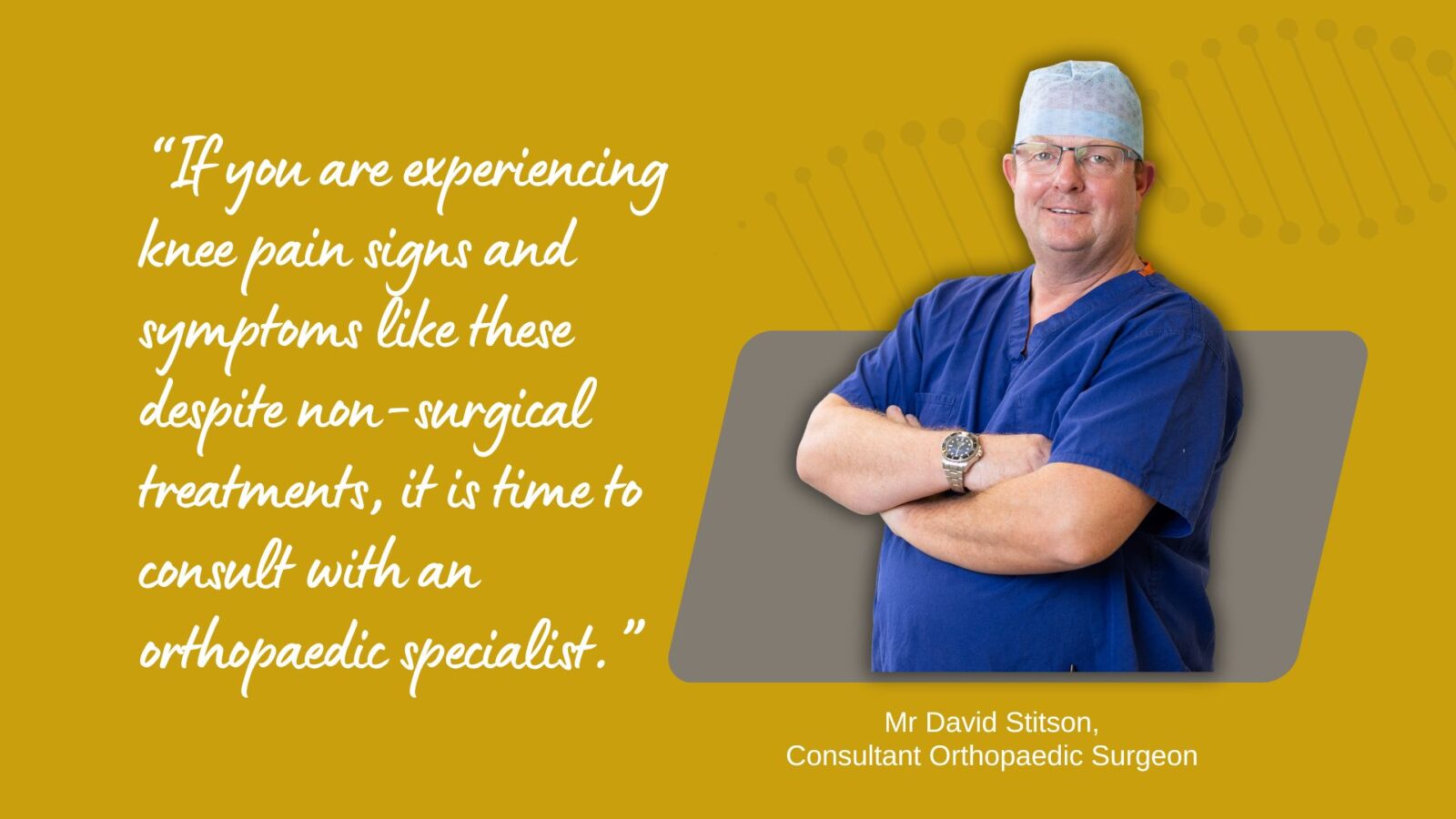
– Speak with Mr Stitson: Book a consultation with David Stitson, a consultant orthopaedic surgeon based in Plymouth, to discuss what might be the best approach for you personally. He will provide detailed information specific to your situation.
Surgery may sound daunting, but for many, it provides much-needed relief and the chance to regain mobility. This step can be pivotal in improving your quality of life, helping to reduce pain and stiffness dramatically.
By addressing the underlying issues, surgery can pave the way for a more active lifestyle, allowing you to return to the activities you love without the constant concern of knee pain holding you back.
Private Knee Osteoarthritis Treatment in Plymouth
Choosing private care allows you to take control of your treatment timeline and receive personalised, consultant-led care close to home.
If you are experiencing knee pain and want clear answers, modern treatment options and timely care, a private orthopaedic consultation in with Mr Stitson n Plymouth can help you regain confidence in your movement.
Book an assessment to understand:
- What stage your arthritis is at
- Which treatments are suitable for you
- Whether surgery is necessary now—or can be delayed
Get Private Orthopaedic Surgery in Plymouth in just 4-6 weeks
⇒ Consultation in 7 days or less
⇒ Consultation to surgery, 4-6 weeks
About Knee Surgery
Knee replacement surgery replaces the worn out, painful and stiff knee joint with a new prosthetic joint. This procedure which may be a partial or a total replacement is normally performed under spinal anaesthesia and is usually followed by a night or two in the hospital. Day-case knee replacement surgery may be an appropriate option for you.

About Mr Stitson
David Stitson is a Plymouth-based Consultant Trauma and Orthopaedic Surgeon. Trained both in the UK and internationally, he has worked in medicine for more than 20 years for the NHS, for the Royal Air Force and in private practice. Mr Stitson operates privately at the Nuffield Health Hospital, Plymouth.

Are you ready to Take the Next Steps to improve your mobility?
Living with constant knee pain is not something you have to accept as part of ageing. Many people in their late 60s and 70s find that a private knee replacement restores their mobility and transforms their quality of life.
📞 To discuss your symptoms and explore whether knee replacement surgery is the right option for you, contact Mr David Stitson, Consultant Orthopaedic Surgeon, at the Nuffield Hospital, Plymouth.
- Call: 01752 761818
- Visit: www.orthopaedicsplymouth.co.uk
- Email: enquiries@orthopaedicsplymouth.co.uk
Take the first step towards a more comfortable, active life today.
The Nuffield Plymouth CQC Rating
The Nuffield Hospital has a history that spans over half a century and has built a reputation for high standards of care, professionalism and expertise in delivering health services. They aim for continuous quality improvement in everything they do.
Active Quality and Governance programmes are in place at the Nuffield Hospital Plymouth. As part of this, the hospital is inspected by independent healthcare regulators to ensure it meets the fundamental standards of quality and safety as determined by the regulating body (CQC).
In the most recent inspection, Plymouth Nuffield Hospital was rated as ‘Good’ overall, however, the surgical element of the inspection was rated as ‘Outstanding’. The hospital was referred to as:
“Outstanding in effective and caring, and
Good in safe, responsive and well-led.”