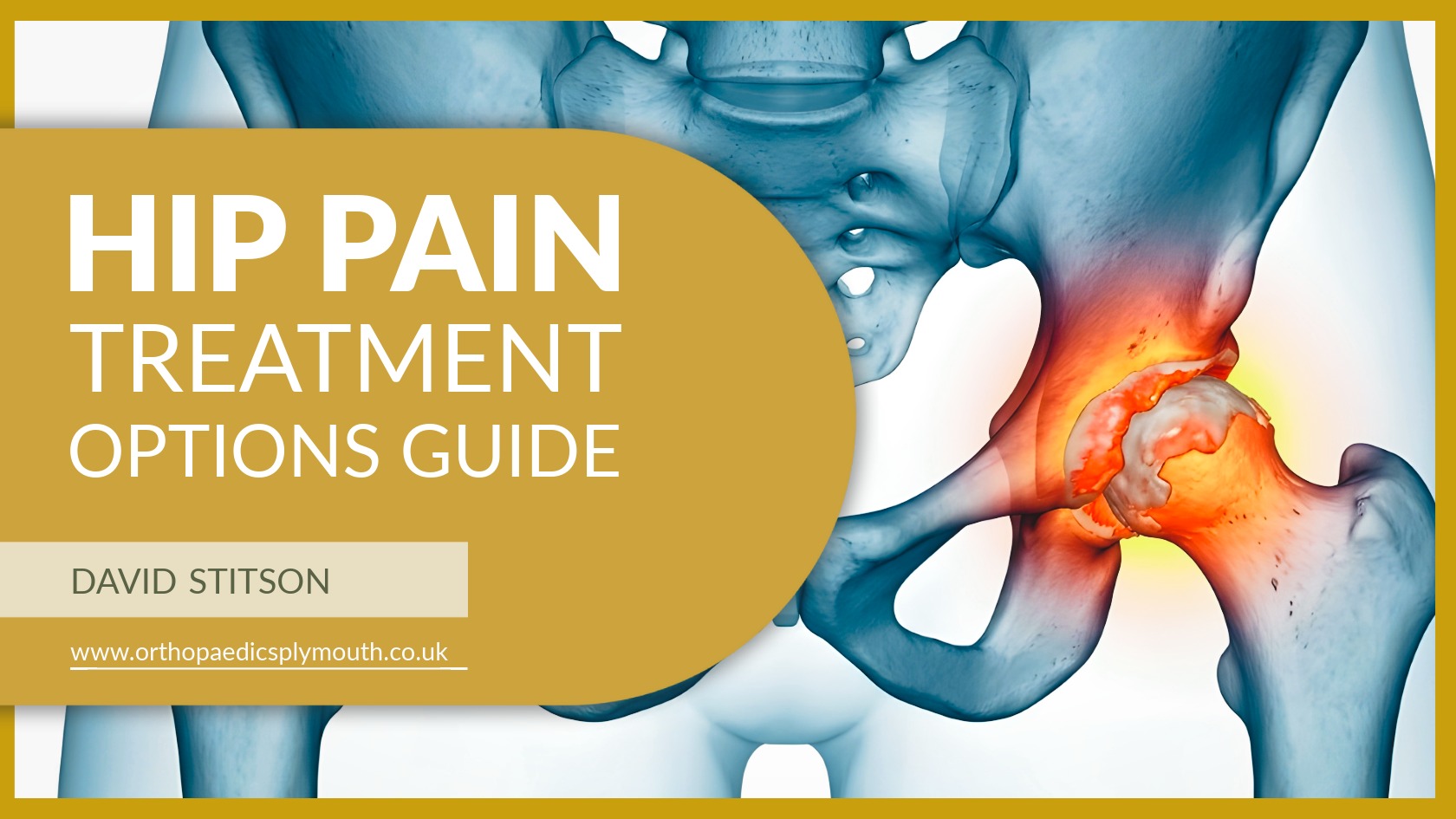
Your Next Steps After Your Hip Pain Assessment
If you have completed the hip pain assessment, the next question is often:
“What happens now?”
The good news is that hip pain can often be treated and surgery is not always the first or only option. Treatment depends on:
Contents
Toggle- Severity of joint damage
- Pain levels
- Mobility limitations
- Impact on quality of life
- Overall health and lifestyle goals
This guide explains the main treatment options available to relieve hip pain, so you can make an informed, practical decision.
Reduce Pain & Boost Mobility
Use this checklist to help decide whether it’s time to speak seriously with Mr Stitson, an experienced hip specialist based in Plymouth.

Step 1 — Lifestyle & Activity Adjustments
In early stages of hip pain, small changes can make a big difference. Helpful changes include:
- Reducing high-impact activities
- Switching to cycling or swimming
- Weight management to reduce joint load
- Using walking aids temporarily if needed
- Adjusting seating and sleeping positions
These steps can reduce strain on the joint and slow symptom progression.
Best suited for:
- Mild symptoms
- Early arthritis
- Occasional hip pain
Step 2 — Physiotherapy & Strengthening
Muscle weakness around the hip often worsens symptoms. A physiotherapist can help strengthen muscles that support the joint and improve movement patterns.
Physiotherapy may include:
- Hip and core strengthening exercises
- Movement correction
- Stretching programs
- Walking and posture training
- Pain management strategies
Best suited for:
- Mild to moderate symptoms
- Early mobility limitation
- Post-injury hip pain
TIP: Physiotherapy may delay or reduce the need for surgery.
Step 3 — Medication & Hip Pain Management
Pain relief medications can help manage symptoms, especially during flare-ups.
Options may include:
- Anti-inflammatory medications
- Pain relief tablets
- Topical gels or creams
- Short-term stronger medication if required
These treatments help manage pain but do not repair joint damage.
Best suited for:
- Occasional flare-ups
- Temporary symptom control
- Supporting physiotherapy
Step 4 — Hip Injection Treatments
Injections may provide temporary symptom relief.
Common injection options
- Corticosteroid injections to reduce inflammation
- Local anaesthetic injections
- Occasionally platelet-rich plasma (PRP) or other regenerative treatments
Relief may last from weeks to several months.
Best suited for:
- Moderate pain
- Patients wishing to delay surgery
- Diagnostic clarification
NB: Injections do not cure arthritis but may improve comfort temporarily.
Step 5 — Hip Replacement Surgery
When hip arthritis becomes advanced, a hip replacement may provide the best long-term solution.
The damaged joint surfaces are replaced with artificial components designed to reduce pain and restore movement. Surgery is usually considered when:
- Pain is present most days
- Walking distance is limited
- Sleep is disturbed
- Medication no longer helps
- Quality of life is significantly affected
Expected benefits include:
- Significant pain reduction
- Improved mobility
- Better sleep
- Increased independence
- Return to activities and travel
GOOD TO KNOW: Modern hip replacements often last 15–25 years or more, depending on activity and health.
How Hip Treatment Decisions Are Made
Hip treatment should be tailored to each patient. Mr Stitson will consider:
- X-ray or scan results
- Pain severity
- Lifestyle goals
- General health
- Recovery expectations
The aim is always to restore comfort, movement, and independence.
Key Message: Hip surgery Is Not Always Immediate. Many patients gradually move through treatment stages:
- Lifestyle changes →
- Physiotherapy →
- Injections →
- Hip Surgery (if needed)
The right time for hip surgery is when pain and limitation outweigh concerns about the procedure.
Questions to Consider After Your Hip Assessment
Ask yourself:
- What activities have I stopped doing?
- Has my walking distance reduced?
- Is sleep disturbed?
- Am I planning life around pain?
If hip pain is affecting daily life, discussing treatment options early can prevent further decline.
Next Step Options
After your hip assessment, you may wish to:
- Book a specialist consultation with Mr Stitson at Nuffield Health, Plymouth Hospital
- Start physiotherapy
- Discuss injection treatments
- Learn about hip replacement recovery
- Monitor symptoms over time
Final Thought
The goal of hip treatment is simple: To help you get back to living life comfortably and confidently.
Take the Next Step…
If hip pain is stopping you from doing the things you love, book a consultation with Mr Stitson to discuss your options.
– Consult Your GP: If you are experiencing hip pain and are considering surgery, start by booking an appointment with your GP. They will be able to refer you to a specialist if needed.
– Understand Your Options: There are the key avenues you can explore to speed up your access to hip surgery contributing to a swifter recovery and getting you back on your feet sooner.
– Do Your Research: Familiarise yourself with different types of hip replacement procedures and what each involves. Knowledge is power!
– Speak with Mr Stitson: Book a consultation with David Stitson, a consultant orthopaedic surgeon based in Plymouth, to discuss what might be the best approach for you personally. He will provide detailed information specific to your situation.
– A consultation helps you understand:
- What is causing your hip pain
- Whether hip surgery is appropriate
- Alternatives to hip surgery
- Expected recovery and outcomes
Hip Replacement Surgery may sound daunting, but for many, it provides much-needed relief and the chance to regain mobility. This step can be pivotal in improving your quality of life, helping to reduce pain and stiffness dramatically.
By addressing the underlying issues, hip surgery can pave the way for a more active lifestyle, allowing you to return to the activities you love without the constant concern of hip pain holding you back.
Taking action now may help you regain confidence, mobility and quality of life.
Get Private Orthopaedic Surgery in Plymouth in just 4-6 weeks
⇒ Consultation in 7 days or less
⇒ Consultation to surgery, 4-6 weeks
About Hip Surgery
Total hip replacement surgery replaces the worn-out painful and stiff hip joint with a new prosthetic joint. This procedure is normally performed under spinal anaesthesia and is commonly followed by a night or two in the hospital. Day-case hip replacement surgery may be an appropriate option for you.

About Mr Stitson
David Stitson is a Plymouth-based Consultant Trauma and Orthopaedic Surgeon. Trained both in the UK and internationally, he has worked in medicine for more than 20 years for the NHS, for the Royal Air Force and in private practice. Mr Stitson operates privately at the Nuffield Health Hospital, Plymouth.

Are you ready to Take the Next Steps to improve your mobility?
Living with constant hip pain is not something you have to accept as part of ageing. Many people in their late 60s and 70s find that a private hip replacement restores their mobility and transforms their quality of life.
📞 To discuss your symptoms and explore whether hip replacement surgery is the right option for you, contact Mr David Stitson, Consultant Orthopaedic Surgeon, at the Nuffield Hospital, Plymouth.
- Call: 01752 761818
- Visit: www.orthopaedicsplymouth.co.uk
- Email: enquiries@orthopaedicsplymouth.co.uk
Take the first step towards a more comfortable, active life today.
The Nuffield Plymouth CQC Rating
The Nuffield Hospital has a history that spans over half a century and has built a reputation for high standards of care, professionalism and expertise in delivering health services. They aim for continuous quality improvement in everything they do.
Active Quality and Governance programmes are in place at the Nuffield Hospital Plymouth. As part of this, the hospital is inspected by independent healthcare regulators to ensure it meets the fundamental standards of quality and safety as determined by the regulating body (CQC).
In the most recent inspection, Plymouth Nuffield Hospital was rated as ‘Good’ overall, however, the surgical element of the inspection was rated as ‘Outstanding’. The hospital was referred to as:
“Outstanding in effective and caring, and
Good in safe, responsive and well-led.”