Supporting Your Knee Pain Assessment Results – What Happens Next?
If you have completed the Knee Pain Assessment, the next step is understanding what treatment options may help you return to a more active, comfortable life.
Contents
ToggleNot everyone with knee pain needs surgery. In fact, many patients improve with non-surgical treatments. The key is choosing the option that matches how much your knee pain affects your daily life.
This guide explains the common pathways available so you can reduce pain & boost mobility.
Reduce Pain & Boost Mobility
Use this checklist to help decide whether it’s time to speak seriously with Mr Stitson, an experienced knee specialist based in Plymouth.

Step 1: Lifestyle & Self-Management Options
These treatments are usually recommended first when symptoms are mild to moderate.
Weight Management
- Even small weight reductions reduce pressure on the knee joint.
- Every extra kilogram adds several kilograms of pressure through the knee when walking.
Activity Modification
Switching from high-impact exercise (running, jumping) to joint-friendly activities such as:
• Cycling
• Swimming
• Walking on softer surfaces
• Strength-based exercise
TIP: These can reduce pain while keeping you active.
Pain Relief Medication
Simple pain relief or anti-inflammatory medication can help manage flare-ups but should not be relied upon long-term without medical advice.
Step 2: Physiotherapy & Rehabilitation
Physiotherapy is often one of the most effective early treatments for alleviating knee pain.
A structured programme can:
• Strengthen muscles supporting the knee
• Improve knee joint stability
• Improve flexibility
• Reduce knee pain during movement
• Improve walking confidence
Physiotherapy is particularly useful when:
• Knee pain has developed gradually
• Weakness or stiffness is present
• Mobility is reducing
Step 3: Injection Treatments
When knee pain persists despite exercise and medication, injections may provide relief.
Steroid Injections
• Reduce inflammation inside the knee joint
• Provide temporary pain relief
• Effects may last weeks to months
Hyaluronic Acid
• Improves knee joint lubrication
• May help mild to moderate arthritis
• Results vary between patients
GOOD TO KNOW: Injections can be helpful when surgery is not yet needed or when patients want to delay surgery.
Step 4: Knee Joint Preservation Treatments
In some cases, particularly in younger or active patients, surgeons may consider procedures aimed at preserving the natural joint.
Options depend on individual circumstances but may include:
• Realignment procedures
• Cartilage repair techniques
• Partial knee treatments
NB: These are not suitable for everyone but may help selected patients.
Step 5: Knee Replacement Surgery
When knee arthritis becomes advanced and pain significantly affects quality of life, knee replacement may be considered. A knee replacement involves resurfacing damaged joint surfaces with metal and plastic components.
Surgery aims to:
• Relieve persistent pain
• Restore walking ability
• Improve sleep
• Restore independence
• Improve quality of life
Typical recovery timeline
• Walking begins immediately with support
• Driving often resumes in 6 weeks
• Major improvement by 3 months
• Continued improvement over 12 months
Choosing the Right Option
The best treatment depends on:
• Pain severity
• Mobility limitation
• Impact on quality of life
• Age and activity goals
• Response to previous treatments
• Overall health
TIP: Your specialist consultation with Mr Stitson helps match treatment to your needs.
Key Message from Your Knee Assessment
The most important question is not:
“How bad does my X-ray look?”
But:
“Is knee pain stopping me living the life I want?”
READ: Is knee pain stopping me living the life I want?
If the answer is yes, it is worth exploring treatment options.
Next Step After Your Assessment
Based on your assessment results, you may wish to:
• Start physiotherapy or lifestyle changes
• Discuss injection options
• Seek specialist consultation with Mr Stitson at Nuffield Health, Plymouth Hospital.
• Explore surgical options if appropriate
The goal is always the same: helping you move comfortably and confidently again.
Take the Next Step…
If knee pain is stopping you from doing the things you love, book a consultation with Mr Stitson to discuss your options.
– Consult Your GP: If you are experiencing knee pain and are considering surgery, start by booking an appointment with your GP. They will be able to refer you to a specialist if needed.
– Understand Your Options: There are the key avenues you can explore to speed up your access to knee surgery contributing to a swifter recovery and getting you back on your feet sooner.
– Do Your Research: Familiarise yourself with different types of knee replacement procedures and what each involves. Knowledge is power!
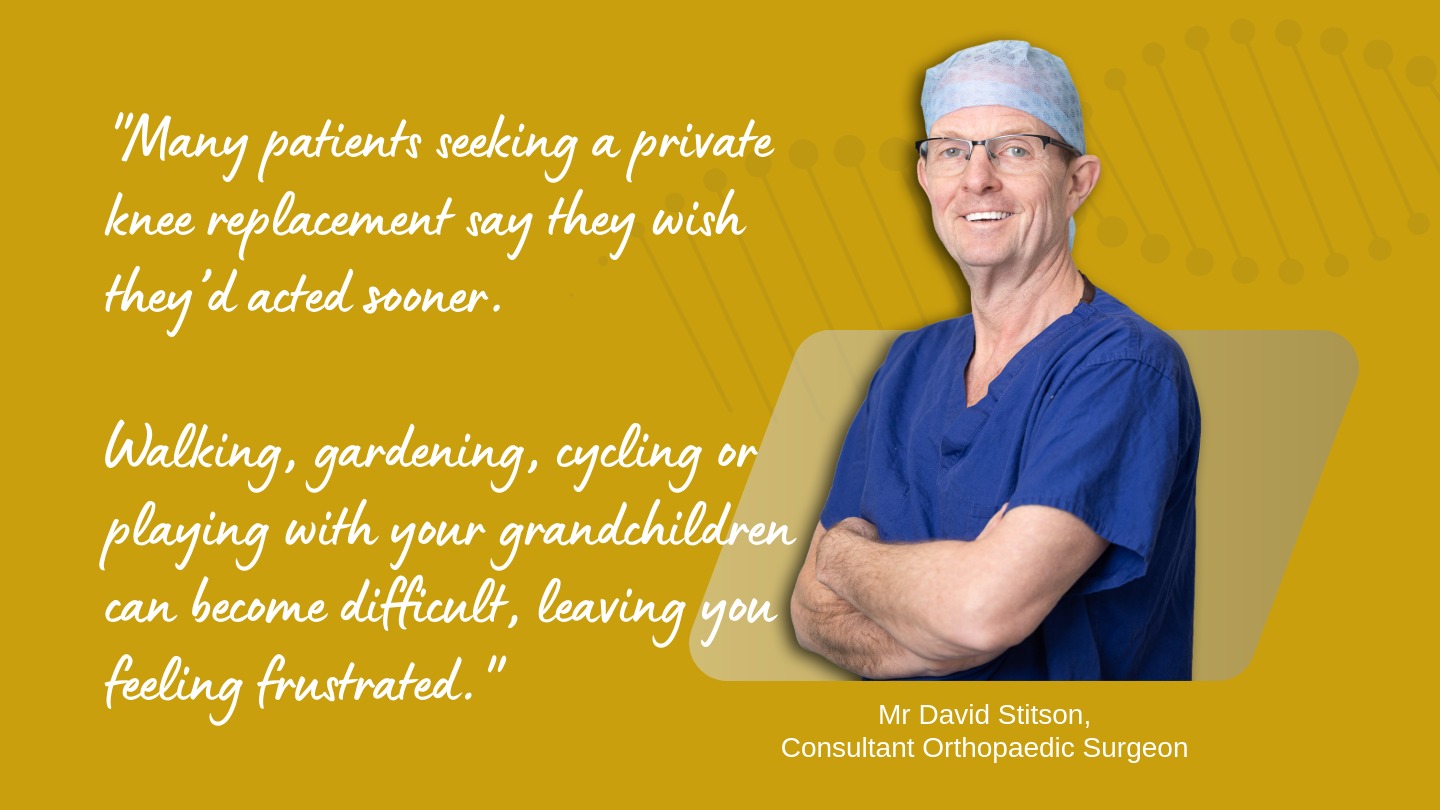
– Speak with Mr Stitson: Book a consultation with David Stitson, a consultant orthopaedic surgeon based in Plymouth, to discuss what might be the best approach for you personally. He will provide detailed information specific to your situation.
– A consultation helps you understand:
- What is causing your knee pain
- Whether knee surgery is appropriate
- Alternatives to knee surgery
- Expected recovery and outcomes
Knee Replacement Surgery may sound daunting, but for many, it provides much-needed relief and the chance to regain mobility. This step can be pivotal in improving your quality of life, helping to reduce pain and stiffness dramatically.
By addressing the underlying issues, hip surgery can pave the way for a more active lifestyle, allowing you to return to the activities you love without the constant concern of hip pain holding you back.
Taking action now may help you regain confidence, mobility and quality of life.
Get Private Orthopaedic Surgery in Plymouth in just 4-6 weeks
⇒ Consultation in 7 days or less
⇒ Consultation to surgery, 4-6 weeks
About Knee Surgery
Knee replacement surgery replaces the worn out, painful and stiff knee joint with a new prosthetic joint. This procedure which may be a partial or a total replacement is normally performed under spinal anaesthesia and is usually followed by a night or two in the hospital. Day-case knee replacement surgery may be an appropriate option for you.

About Mr Stitson
David Stitson is a Plymouth-based Consultant Trauma and Orthopaedic Surgeon. Trained both in the UK and internationally, he has worked in medicine for more than 20 years for the NHS, for the Royal Air Force and in private practice. Mr Stitson operates privately at the Nuffield Health Hospital, Plymouth.

Are you ready to Take the Next Steps to improve your mobility?
Living with constant hip pain is not something you have to accept as part of ageing. Many people in their late 60s and 70s find that a private knee replacement restores their mobility and transforms their quality of life.
📞 To discuss your symptoms and explore whether knee replacement surgery is the right option for you, contact Mr David Stitson, Consultant Orthopaedic Surgeon, at the Nuffield Hospital, Plymouth.
- Call: 01752 761818
- Visit: www.orthopaedicsplymouth.co.uk
- Email: enquiries@orthopaedicsplymouth.co.uk
Take the first step towards a more comfortable, mobile life today.
The Nuffield Plymouth CQC Rating
The Nuffield Hospital has a history that spans over half a century and has built a reputation for high standards of care, professionalism and expertise in delivering health services. They aim for continuous quality improvement in everything they do.
Active Quality and Governance programmes are in place at the Nuffield Hospital Plymouth. As part of this, the hospital is inspected by independent healthcare regulators to ensure it meets the fundamental standards of quality and safety as determined by the regulating body (CQC).
In the most recent inspection, Plymouth Nuffield Hospital was rated as ‘Good’ overall, however, the surgical element of the inspection was rated as ‘Outstanding’. The hospital was referred to as:
“Outstanding in effective and caring, and
Good in safe, responsive and well-led.”